Interview
Kaandi Kalakar In Conversation with Art Beyond Contemporary
Interviewed by Rageshree Ranade for Art Beyond Contemporary
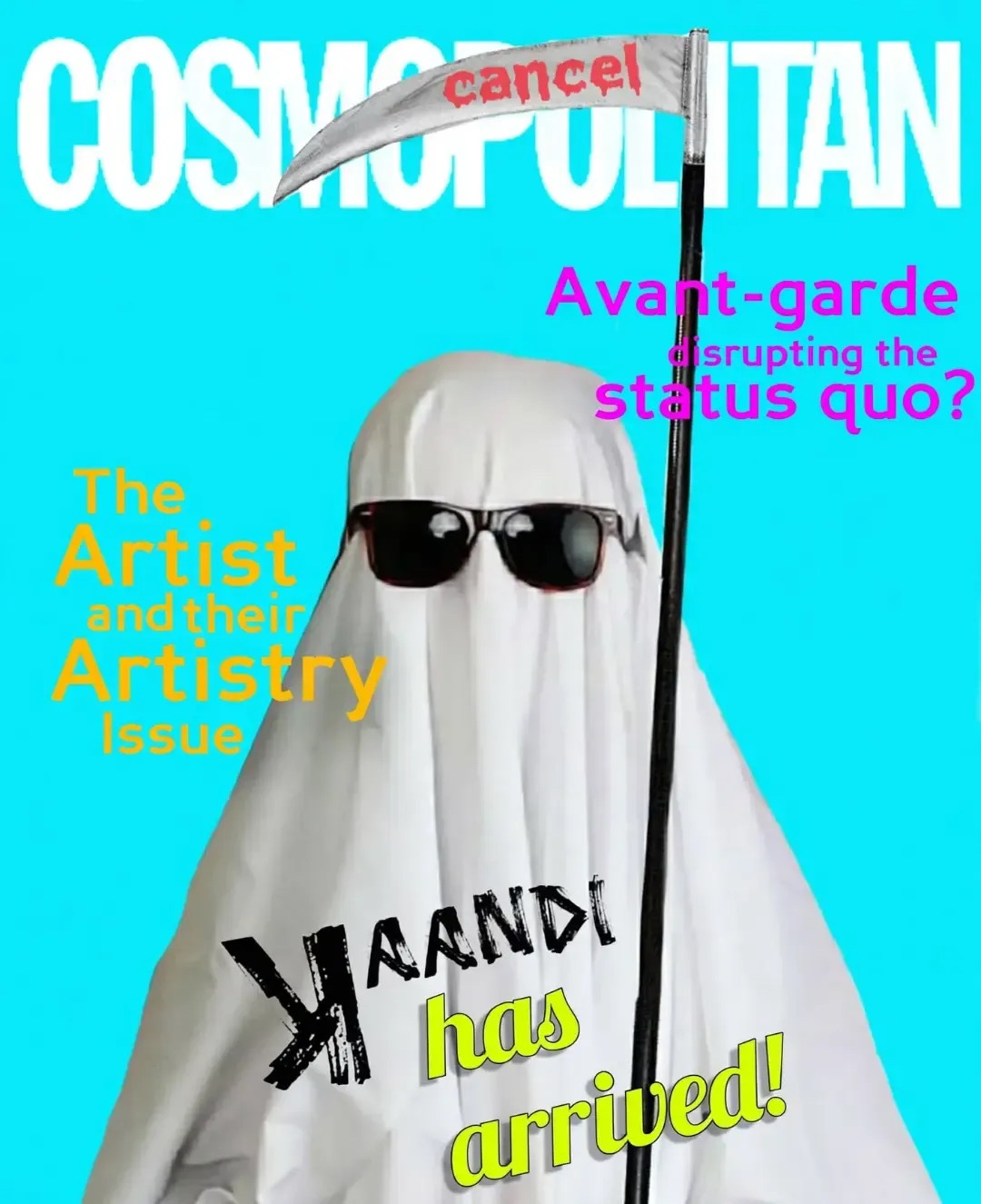
Kaandi Kalakar
Kaandi Kalakar is an anonymous Instagram account that has made a habit of saying the quiet part out loud in the Indian art world. Through memes, accusations, satire and political commentary, it takes aim at the institutions, networks and carefully cultivated relationships that shape the field. Its feed moves between caste critique, institutional criticism and the appropriation of images, often with little regard for the niceties the art world holds dear.
But who, or what, is Kaandi? A critic, a provocateur, a necessary nuisance or another player in the very power games it claims to expose? And when you build a platform around calling people out, who gets to call you out?
In this conversation, we talk about vision, legacy, sustainability, labour, and what it truly means to sustain an art practice beyond trends, beyond markets, and into something much more enduring.
Rageshree Ranade: So who or what is Kaandi? Is Kaandi a person, a persona, a collective, an artistic practice, a critic, or an experiment in what criticism can become when it refuses to identify itself?
Kaandi Kalakar: A mirror? Troll? Vandal? Genius? Loser? Avant-garde? Kaandi,
whose pronouns are “multidisciplinary/multimedia”. Jk!
Kaandi
has indeed been a post-avant-garde phenomenon since its inception, perceived as
an extension of digital vandalism, a bit of a prosecutor, a bit of a catalyst,
and a politically charged disruptor responsible for some mischievous happenings
(“Kaand” in the Indian art world).
Kaandi
could be AI or analog, acting “collectively” or, at times, “single-handedly” to
cause a splash that stirs into a storm in these times of over-identification
and over-representation.
RR: There is an uncomfortable claim running through your content: that criticism in Indian art has become less about judgement and more about maintaining relationships. Is criticism actually dead or simply too expensive to be honest?
KK: It may indeed feel unsettling and uncomfortable for those still living in their bubble of denial! The monkey business that was cleverly covered up is now being exposed: you scratch my back, I’ll scratch yours. You come to my show, I’ll come to yours!
Everything is shrinking to desperate networking and PR. Criticism isn’t dead, but it has been sidelined and overshadowed by sponsored art writers whose patronising, flattering, bland, “appreciative and promotive” articulation hardly has any critical tone. Nobody would spend a penny if critical writing brought down the buzz or sales.
Those who are trying are also choosing the same elite tonality, ironically serving the very structure they claim to question. They want their “criticism” validated and accepted by the same spineless system! There’s no doubt that emerging critical voices are shunned, silenced, and suppressed. Throwing wine and cheese is the easiest way to corrupt them.
And if that isn’t convincing enough, why has no art writer, critic, or collective cared to interview Kaandi after more than five years of consistently contributing to critical discourse? Everyone wants either money or recognition!
RR: You repeatedly invoke words like “nexus”, “gatekeeping”, “nepotism”, and “sycophancy”. What do these structures actually look like when you take them out of the vocabulary of outrage and put them under a microscope?
KK: The sycophants! The lickers! The loyal tail-waggers! The puppets! The people-pleasers!
As long as you promote and praise them, are hyper-visible at openings, are “well-connected” on social media, can sophisticatedly sugarcoat things, and have a good number of followers, you’re in!
Unfortunately, nothing is about creative skills, talent, or vision anymore. Most of these grantees and awardees are asset slaves of the gallery system and institutions, without an active or opinionated voice. Dare to challenge their views and ideologies or be honest about their actions, and you lose out!
It’s far more than nepotism. It’s a complicated network or “nexus” of class, caste, religion, gender, privilege, and communal or professional benefits operating in tone-deaf white cubicles. They follow a pattern: every year, the same names of artists keep circulating.
These structures shouldn’t be taken out of the vocabulary of outrage. Artistic conscience shapes society, and if that conscience is corrupt, everyone suffers, at both the macro and micro levels!
RR: Your “RESERVATION & CASTE” intervention asks what happens when the language of “merit” enters the gallery. Why do you think caste remains so difficult for an art world that otherwise likes to think of itself as progressive?
KK: It’s easier to imagine the end of capitalism than the end of casteism in the Indian art context. Difficult? It’s impossible.
Other industries have their own complexities when it comes to caste, but the art world hits a new low every microsecond. Discourse against casteism and other social problems is blown out of contextual relevance whenever it suits someone’s cause or convenience.
Ultimately, and ironically, every small effort or initiative has only benefited the “pretentiously progressive” structures that have always held power and occupied the top of the hierarchy.
Look at the data and statistics. How much has any community project actually achieved or impacted the lives of that community financially, culturally, or otherwise, compared with the individual or collective organising it?
RR: You have been particularly uncompromising around abuse, enablers, and predators. Where, for you, does accountability end and cancellation begin?
KK: It’s an extremely sensitive matter that, unfortunately, has received the most insensitive treatment from every direction. Look around: all the #MeToo men are still on panels and exhibiting, with enablers in attendance!
Do you think honest and genuine accountability could deliver justice for survivors or the oppressed? When the system and institutions of justice fail, we have to come up with alternatives like mass cancellation.
Of course, this must follow proper fact-checking and verification. But the past has shown that the most shocking episodes emerge from the most unexpected spaces and people. In such cases, spreading awareness about a predator or abuser can save many lives.
But one must never forget the consequences of false accusations, either! With time, people, especially those dealing with such episodes, develop the ability to filter out false projections, made-up narratives, and fake auras and energy. One knows! Everyone knows!
Sadly, people then choose either to raise their voices or remain conveniently silent. I’m sure that when the Nana Patekar of the art world dies, “bartans and buckets” of tears will be shed.
RR: You have positioned Kaandi as a democratic space for questions and engagement. But can a crowd-sourced criticism platform remain democratic once the crowd starts behaving like a mob?
KK: Mob mentality is indeed potentially very dangerous. But what is observed, absorbed, and perceived through the sieve of “collective consciousness” helps draw the line.
Attempts are made to verify, fact-check, and filter information. There can be lapses because the artistic “crowd” often operates on a sentimental frequency.
Anyone who understands the process of churning also knows the value of buttermilk and butter! Mutual public engagement gradually turned this into a democratic forum.
RR: Why does KaRR: Why does Kaandi choose the meme where another critic might choose the essay?andi choose the meme where another critic might choose the essay?
KK: It’s the “Kalakaar” suffix following “Kaandi” that makes me do it!
We live in times of a “15-second reel” attention span. You blink, and the world changes. The language politics of visuals reaches people more effectively in these times, especially where a bland essay falls flat.
Moreover, responding by mimicking the visual language of these big-shot “contemporary” artists serves poetic justice: a taste of their own medicine!
Most importantly, the power of humour and satire is underrated when it comes to sensitisation. And when and where has “confusingly nodding” at some crappy installation on a white wall ever got us anywhere?
RR: Some of your recent posts question whether the art world can continue celebrating itself while the society around it is in crisis. But should art ever stop? When exhibitions, parties, and cultural events continue during political or social crises, when does that become privilege or detachment? Conversely, when does demanding that art stop become another form of political control? Where do you draw the line between artistic responsibility and political policing?
KK: This is such a relevant question!
Art, which can also be considered a form of energy, has been eternal. It’s our sense of human superiority that makes us think, almost believe, that we can start or stop it!
Kaandi was never against art in the first place. The concern is with the problems that arise before and after the “artistic” act of expression. Politics and art could be two sides of the same coin.
Political policing requires greater awareness, consciousness, and sensitivity. It makes practitioners ask: “Where does the artistry end and activism begin, or vice versa?”
But we can’t have the same “politically correct” expectations of art and artists. Factuality often punctures imagination.
You may want to refer to one of Kaandi’s posts where an artist’s way of living aligns with that of a criminal. It’s important to deconstruct this “optimistic” notion of art. Since time immemorial, art has also been used for evil intentions!
RR: You have gone after both easy targets and people with considerably more power. Forget followers, likes, and virality for a moment. What has Kaandi actually risked, and what has it actually changed?
KK: Haha! From small fish to big whales! Indeed, exposed and cancelled them all!
Big and bold actions have big consequences. What might appear to be simple “trolling” has put not just one life, but many, at risk.
An extremely powerful museum, with the help of another “non-profit” organisation, tried to blackmail and legally threaten us over identification. Due to some loopholes and their own screw-ups, things were temporarily settled.
The handle was later hacked and deactivated for a few months by some RW IT cell! But people in this country are suffering and going through so much at their hands.
Every risk was worth it. From making the country’s biggest ART circus (fART Fair) remove its problematic social media posts to making curators and institutional faculty members resign and helping survivors call out their abusers and harassers and take action.
I must also add, immodestly, that the handle’s efforts have helped mentor over 30 students pursuing their desired art courses and assisted more than 50 students during COVID with rations, mental health support, and legal facilities.
RR: Every critic keeps an archive of other people’s failures. What does Kaandi’s archive of its own failures look like?
KK: Absolutely! I’m a huge supporter of the cliché that “there’s nothing in life called failure, only lessons to learn from.”
Failures of a sort were the very reason the handle came into existence, but the handle itself has also failed on certain occasions: by using problematic vocabulary or terminology and by using methods that relied on shock value to gain attention.
I couldn’t deal with or help every case that went beyond my reach or radar.
The biggest failure was being unable to stop a show from happening, despite multiple pieces of evidence and witnesses against a curator who was a harasser and took pictures of people without their consent.
But this was a timely reminder not to expect too much from the handle because, ultimately, it is a product of the same system! Only poison cuts poison. You have to step into the dirt to remove it. But one must never stop learning, perhaps!
RR: Finally, if the Indian art world genuinely changed tomorrow; if criticism became independent, gatekeeping weakened, institutions became more accountable, and the conditions you object to disappeared, would Kaandi shut itself down? Would the disappearance of @kaandikalakar be your greatest accomplishment? Or has Kaandi become something that now exists beyond the problems that created it?
KK: Disappearing is indeed the greatest dream! In fact, I tried to do it, but archiving the content made the problem-makers more active again. The nexus! The abusers! So it was important to unarchive everything for the upcoming generation.
Kaandi emerged on its own terms, partly because of the pandemic, and will fade away in the same fashion: of its own will!
What a utopian imagination it is to think, even hypothetically, that everything will eventually get better in the art world! There’s absolutely no harm in dreaming.
But what one can sense is that Kaandi is no longer just an Instagram handle limited to a “destructive or disruptive” genius idea. Nor is it simply an art movement influenced by the West (not really!). It has evolved in response to the shortcomings and ruptures in the Indian art ecosystem.
It has transformed to such an extent that even if the handle ceases to exist, its intentions, sentiments, and objectives will remain in people’s hearts, minds, and actions.
RR: If Kaandi demands transparency, evidence, and accountability from the art world, what should the art world be entitled to demand from Kaandi? What does Kaandi owe the people it critiques?
KK: The only thing Kaandi initially had a confident clarity about was the power dynamics of anonymity. Too much courage and honesty often backfire and leave the motive unaccomplished.
Kaandi isn’t trying to balance an equation with an art world that has an unasked demand for which there should be a supply!
Kaandi owes nothing to the people it critiques! It only asks for what working people deserve. It is simply giving back hard to what exploitative people deserve.
Of course, this is problematic on many levels! The very idea of identity within the Indian art community comes with its own package of problems. If you’re a marginalised minority, the oppressors won’t let you do your work. If you’re in the majority, the “wokes” will cancel you, diffusing the objective.
How will anyone seriously consider your proposition if they first want to associate with, attack, or corrupt your existence based on your gender, caste, religion, political inclinations, profession, and so on, before listening to your grievances?
Anonymity dodges and dissolves all of this. It has proved to be an unbiased positionality.
And it’s not as though the art world listens to every demand Kaandi makes! This conversation marks the beginning of an ongoing editorial series by Art Beyond Contemporary, engaging in dialogues with practitioners and cultural mediators across disciplines. The intention is to create a space where practice can be discussed with depth and care, looking beyond exhibitions towards the systems, labour, and thinking that sustain them.
RR: There is an uncomfortable claim running through your content: that criticism in Indian art has become less about judgement and more about maintaining relationships. Is criticism actually dead or simply too expensive to be honest?
KK: It may indeed feel unsettling & very uncomfortable for those who are still living in their bubble of denial! The monkey business that was very cleverly covered /protected is just getting exposed: you scratch my back and I’ll scratch yours…you come to my show, I’ll come to yours! Everything is shrinking to desperate networking and PR! Criticism is not dead but sidelined, overshadowed by sponsered art writers with their patronising, flattering bland “appreciative & promotive” articulation that hardly has any critical tone to it! Nobody would spend a single penny if anything critically penned would bring the buzz or sales down. The ones who are also trying, are also choosing the same elite tonality that ironically is just serving the same structure! They want their “criticism” validated and accept by the same spineless system! There is no doubt that emerging critical voices are shunned, silenced and suppressed. Throwing wine & cheese is the easiest way to corrupt them.
And if that’s not convincing enough then what explains: Why no art writer/critic or collective never cared to interview Kaandi after contributing 5+ proactive years of consistency in critical discourse? Everyone wants either money or recognition!
RR: You repeatedly invoke words like “nexus”, “gatekeeping”, “nepotism” and “sycophancy”. What do these structures actually look like when you take them out of the vocabulary of outrage and put them under a microscope? OR Who gets the gallery show, the residency, the grant, the institutional position or the curator’s attention and who doesn’t? Is this primarily a question of nepotism, or is it a more complicated network of class, caste, education, money, friendship and professional proximity?
KK: The Sychophants! The lickers! The loyal tail waggers! The Puppets! The people pleasers! As long as you’re promoting/praising them, are hyper-visible in the openings, are “well-connected” on socials, can sophisticatedly sugarcoat things! Have good number of followers! Unfortunately nothing is about creative skills/talent or visionaries now! Most of these grantees/awardees are asset slaves of gallery system/institution who won’t have an active or opiniated voice. You dare to challenge their views, ideologies and be honest about their doings & you lose it! You’ll be isolated or ostracised. You don’t just become a threat but a liability! It’s far more than just a question of Nepotism! Indeed a more complicated network or “Nexus” of class, caste, religion, gender, privilege, communal or professional benefits! that operates in tone deaf white cubicles. They have a pattern: every year you’ll see the same list of names of same artists that will keep getting circulated! The same “not so naive” pawns getting awards, grants, residency etc. hence making it an echo chamber. But so glad that people have been calling this out now! And these structures should not be taken out from the vocabulary of outrage as artistic conscience shapes the society, and if that is corrupt, everyone suffers! On macro & micro level!
RR: Your “RESERVATION & CASTE” intervention asks what happens when the language of “merit” enters the gallery. Why do you think caste remains so difficult for an art world that otherwise likes to think of itself as progressive?
KK: It’s easier to imagine end to capitalism than end to casteism in Indian Art Context. Difficult? It’s impossible tbh. Other industries have other complexities when it comes to caste but it hits a new low every micro second in the artworld where the discourse against casteism and other social problems have been totally blown out of contextual relevance on each one’s cause of convenience. Ultimately & Ironically every small effort/intiative has only benefitted the “pretentious progressive” structures that have always been in power, always on the top in hierarchy. Go through the data, statistics and see how much any community project has achieved or had an impact (financially, culturally or of any other kind) on the lives of that community itself in comparison to an individual/collective organising it.
RR: You have been particularly uncompromising around abuse, enablers and predators. Where, for you, does accountability end and cancellation begin? OR When does continued association with an accused artist constitute complicity, and when does it become guilt by association? What is your threshold before naming someone publicly? How do you distinguish between an allegation and an established fact? In extension, what happens when Kaandi gets it wrong?
KK: It’s a hypersensitive matter that unfortunately has received the most insensitive treatment from every direction. Look around: all of the #metoo men still on the panels/ doing shows attended by enablers! You think honest & genuine accountability could do any justice for the survivors or the oppressed? When the system/body of justice fails, one has to come up with alternatives like mass cancellation! Ofcourse only after proper fact checking/ verification, but past is the proof that the most shocking episodes come from the most unexpected spaces and people. So in such cases, atleast spreading awareness about a predator/abuser can save so many lives. But one must never forget the consequence of false accusations too! But you know, with time people (especially dealing with such episodes) develop the ability to filter through false projection, made up narratives, fake aura & energy. One knows! Everyone knows! And sadly then they make a choice to either raise their voice or to remain conveniently silent. I am sure when Nana Patekar of Artworld dies, “Bartans & Buckets” of tears will be shed.
RR: You have positioned Kaandi as a democratic space for questions and engagement. But can a crowd-sourced criticism platform remain democratic once the crowd starts behaving like a mob?
KK: Mob mentality indeed is potentially very dangerous. But what is observed, absorbed, perceived through the seive of “collective consciousness” helps a bit to draw the line. Attempts are made to verify/fact check and filter out information. Many a times, there could be lapses because the artistic “crowd” often operates on sentimental frequency. One who knows the process of churning also knows what value buttermilk and butter has! The mutual public engagement gradually made it into a democratic forum.
RR: Why does Kaandi choose the meme where another critic might choose the essay?
KK: It’s the “Kalakaar” suffix followed by “Kaandi” that makes to do it! Living in the times of “15 second reel” attention span, you blink and world changes! An essay or article has the tendency to exclude a great number of masses that cannot comprehend heavy Jargons, the language politics of visuals in such times reaches with more impact. Especially amongst those where the bland essay lands flat. Moreover responding via mimicking visual language of these big shot “contemporary” artists serves more poetic justice; taste of their own medicine! And most importantly the power of humor/satire is underrated when it comes to sensitisation! And also when and where has “confusingly nodding” to any crappy installation on a white wall lead us anyway?
RR: Some of your recent posts question whether the art world can continue celebrating itself while the society around it is in crisis. But should art ever stop? ( When exhibitions, parties and cultural events continue during moments of political or social crisis, when does that become privilege or detachment? Conversely, when does demanding that art stop become another form of political control? Where do you draw the line between artistic responsibility, and political policing?)
KK: This is such a relevant question! Art which can also be considered as a form of energy has been eternal! And it’s just our humane superiority which thinks (almost believes) that we can either start or stop it! Kaandi was never against art at the first place; the concern is more about the problematics that happens before and after the “artistic” act of expression! Politics and art could be sides of the same coin! Political policing requires more awareness and even better degree of consciousness or sensitiveness; making practitioners think: “where does the artistry end and activism begin or vice-versa”! But we can’t have same “politically” correct expectations from art and artists. Factuality often punctures imagination.
You may want to refer to one of Kaandi handle’s post where artist’s and criminal way of living aligns. It’s very important to deconstruct this “optimistic” nature/notion of art. Since time immemorial art has also been used for evil intentions!
Art may never stop, but mindfully; it can certainly pause and can also be temporarily muted for addresal of a major cause. Like we’ll be delaying a bit to publish this interview because of the ongoing protest!
RR: You have gone after both: easy targets and people with considerably more power. Forget followers, likes and virality for a moment. What has Kaandi actually risked, and what has it actually changed?
KK: Haha! From small fishes to big whales! Indeed exposed / cancelled them all! Big and bold actions also have big consequences. What may just project as simple “trolling”, risked not just one single life but many. An extremely powerful museum with the aid of another “non-profit” org tried to blackmail and legally threatened to compromise on identification grounds . Due to some loopholes and their own screw ups, things were temporarily settled. The handle was later hacked then deactivated for a few months by some RW IT cell!. But then people in country are suffering/going through so much under their hands. However, indeed every risk was worth it. From making the biggest ART circus (fART Fair) of the country to remove theirs problematic social posts, making curators / institutional faculty members resign, helping survivors calling out their abusers/harassers to take actions. It must also be added to immodesty but parallely through handle’s efforts:
30+ students were mentored to pursue their desired art courses, aided 50+ students during covid for their ration and mental health/ legal facilities etc.
RR: Every critic keeps an archive of other people’s failures. What does Kaandi’s archive of its own failures look like? (Have you ever discovered that your information was incomplete, deleted a post, apologised or changed your position? More importantly, how do you distinguish between being wrong and being censored?)
KK: Absolutely! A huge supporter of the cliche “there’s nothing in life called a failure, but lessons to learn from”. Failures of sort were the very root cause for the handle to come into existence but also many a times the handle itself failed on certain occasions! For using problematic vocabulary/terminologies, methods for creating shock value to gain attention. Couldn’t deal and help with each and every case that went beyond reaches/radar. Biggest one was: Couldn’t stop a show from happening, despite having multiple evidences/witnesses against a curators who was an harassers, and takes pictures of people without consent! But it was reminded timely to not expect much from this handle because at last; it is the product of the same system! Only poison cuts poison! You have to step into dirt to remove it.
(Methaphor) But one must never stop learning perhaps!
RR: Here is the paradox I keep coming back to: what happens when the anti-gatekeeper becomes a gatekeeper? ( Imagine Kaandi becoming powerful enough that artists worry about appearing on the account, curators begin checking what you think before making decisions, galleries manage their reputations around your posts, and young artists start seeking your approval. You would then possess precisely the kind of cultural power that you currently question. So who watches Kaandi?)
KK: Strangely this surreal Paradox has become reality! There have been active talks in groups & circles where some of them actually do fear the “Kaandi effect”! (That’s what they call it apparently) Some curators/artists take it in a healthy sense, enjoy it and feel more responsible for their conduct. They consider their mention on this handle as their “arrival”! That they have officially made it! However, this kind of power may seem/imply similar to “gatekeeping” but it’s not! Why? Because the intentions/efforts have always been inclusive, mostly transparent, unbiased, approachable etc. And if in any case not, then there must have been exceptions! Because we also have clever people who wish to benefit from both the sides, they want the grant money and yet want to cancel the organisation! You ask who watches Kaandi? The world always tries to cancel the one who cancels them, forgetting the basic principles of integers!People who do not dare to question the filthy corrupt system loves to give Kaandi reality checks, because they can do so! And they must do so!
RR: Finally, if the Indian art world genuinely changed tomorrow if criticism became independent, gatekeeping weakened, institutions became more accountable and the conditions you object to disappeared, would Kaandi shut itself down? Would the disappearance of @kaandikalakar be your greatest accomplishment? Or has Kaandi become something that now exists beyond the problems that created it?
KK: Disappearing is indeed the greatest dream! Infact, did try to do it but sadly archiving the content was making the problem makers more active again! The Nexus! The abusers! So it was important to unarchieve everything for the upcoming generation. Kaandi emerged on its own term ( also because of Pandemic) and would also fade away in the same fashion! On its own will! What a eutopian imagination to hypothetically think of a future that every thing will eventually get better in the artworld! And there’s absolutely no harm in dreaming so. But what one can sense is that “Kaandi” is not just an Instagram handle limited to a “destructive or disruptive” genius idea! That, like any art movement was influenced from the west(not really!) It has evolved in accordance to shortcomings & ruptures in Indian Art Ecosystem. It has transformed to such an extent; that even if the handle ceases to exist, the intention, sentiments and objectives would stay in hearts, mind & actions of the people.
RR: And perhaps the most uncomfortable question: Does anonymity make criticism more courageous, or potentially less accountable? If Kaandi demands transparency, evidence and accountability from the art world, what should the art world be entitled to demand from Kaandi? What does Kaandi owe the people it critiques?
KK: It is not at all uncomfortable honestly! The only confident clarity Kaandi “initially” had was about the power dynamics of anonymity! Too much courage & honesty often backfires and leaves the motive unaccomplished. Kaandi is not trying to balance any equation with artworld that has an unasked demand for which there should be a supply! Kaandi owns nothing to people it critiques! It only asks for what laboring people deserve! It is only giving back HARD to what the exploitative people deserve. Which ofcourse is very problematic on many levels! The very idea of identity in Indian art community comes with its own package of problems. If you’re a marginal minority : the oppressors won’t let you do your work. If you’re a majority: the “wokes” will cancel you which diffuses the objective. How will anyone seriously consider your proposition if you function in a space where one would first want to associate/attack or corrupt your existence by knowing your gender, caste, religion
political inclinations, profession etc. & then listen to your grieviances? The anonymity dodges & dissolves it all. It proved to be an unbiased positionality. And as if the artworld listens to each and every demand that Kaandi makes!
This conversation marks the beginning of an ongoing editorial series by Art Beyond Contemporary to engage in a series of dialogues with practitioners and cultural mediators across disciplines. The intention is to create a space where practice can be discussed with depth and care, looking beyond exhibitions toward the systems, labour, and thinking that sustain them.